
Posts
Doodh Laddu Sweet — Jaipur’s Most Authentic Milk Ladoo Guide 2026

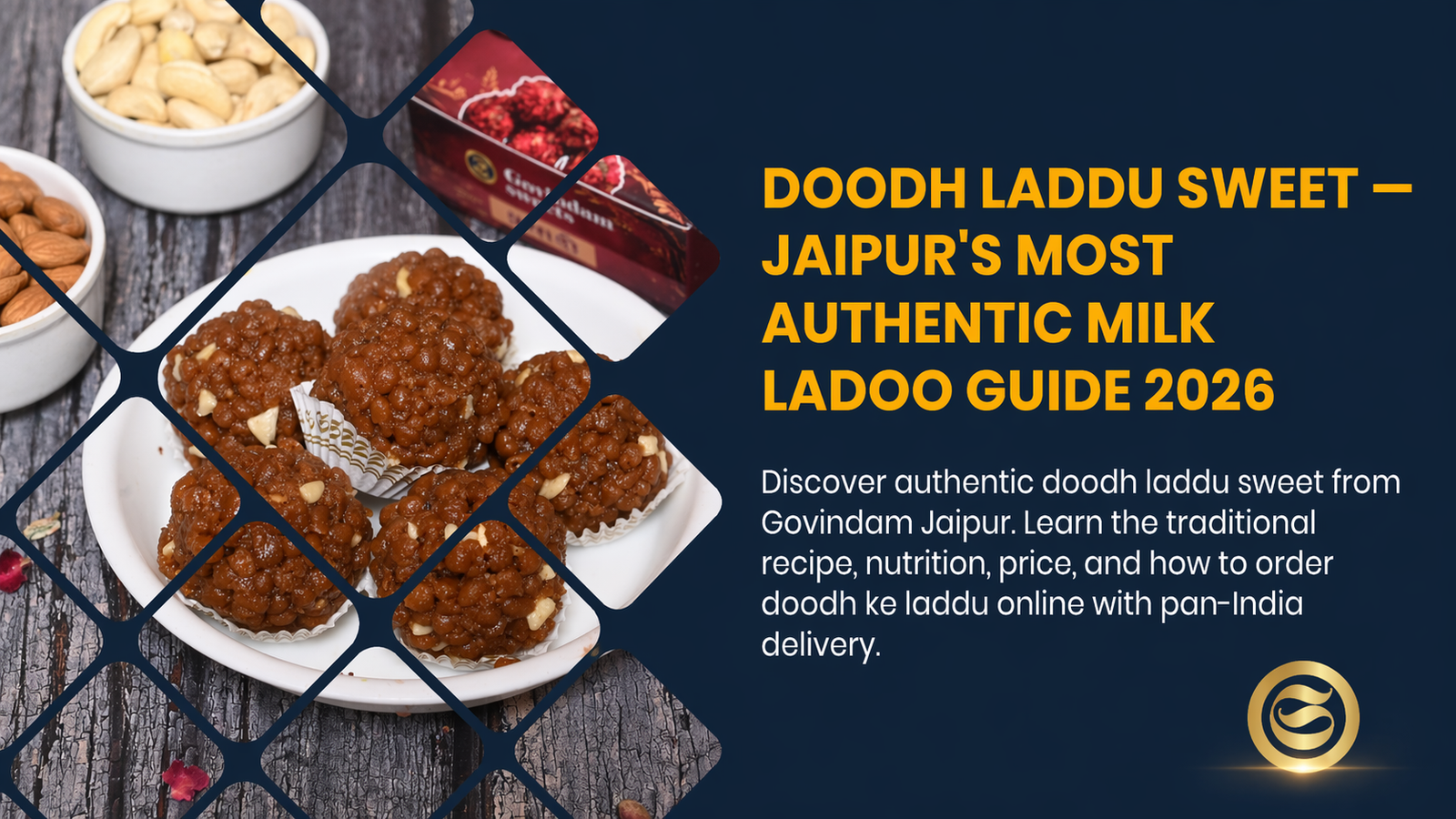
Doodh laddu sweet is one of Rajasthan’s most nourishing traditional mithai — soft, milk-dense balls made from reduced full-fat milk, pure desi ghee, and fragrant cardamom. Govindam Sweets Jaipur has crafted authentic doodh ke laddu since 1985 near Govind Dev Ji Temple. Order online with pan-India delivery and 100% freshness guaranteed.
Doodh Laddu Sweet — Jaipur’s Most Trusted Milk Ladoo
By Govindam Sweets | Master Confectioners | Near Govind Dev Ji Temple, Gangori Bazaar, Jaipur | FSSAI Certified | Est. 1985 Published: April 2026 | Reading Time: 11 Minutes

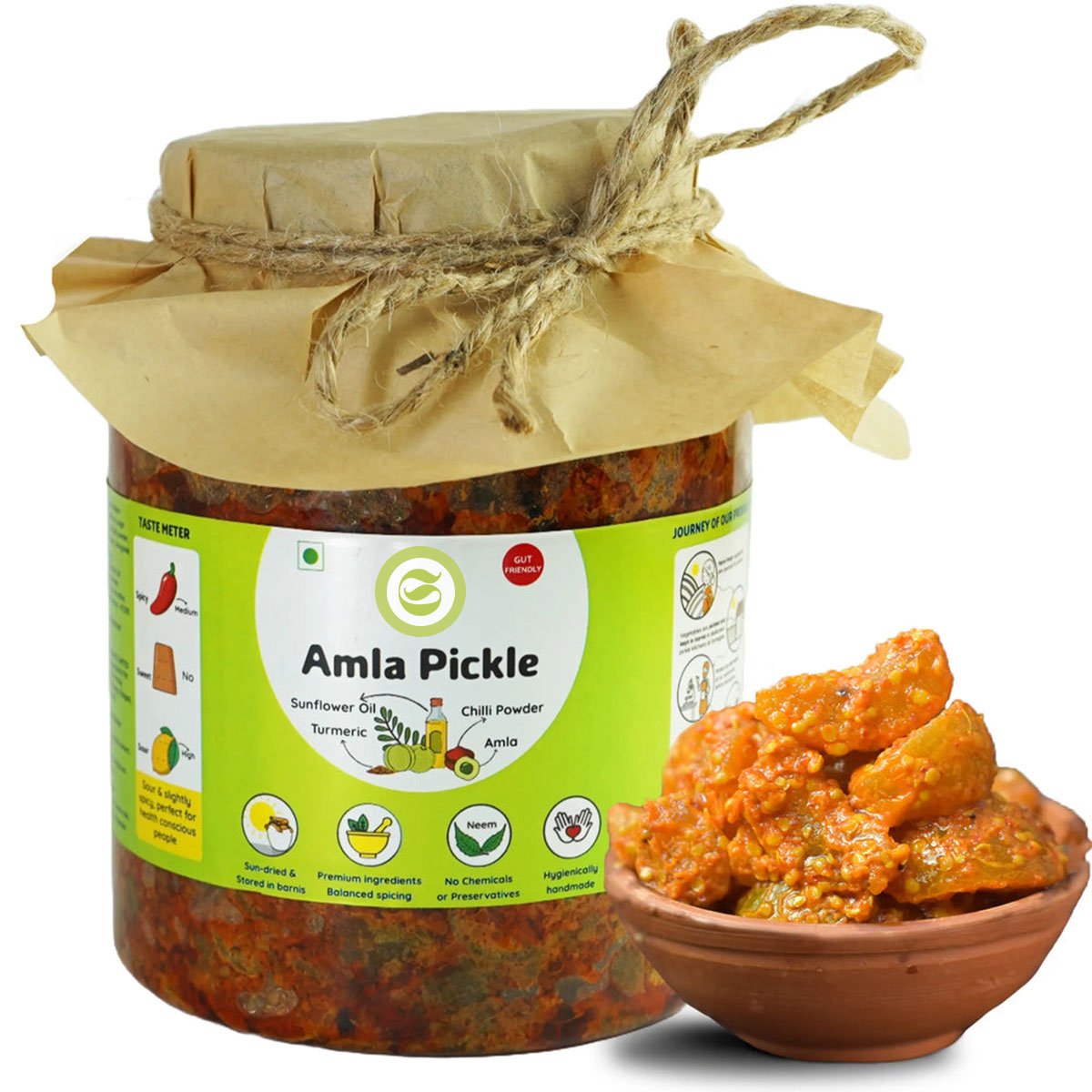
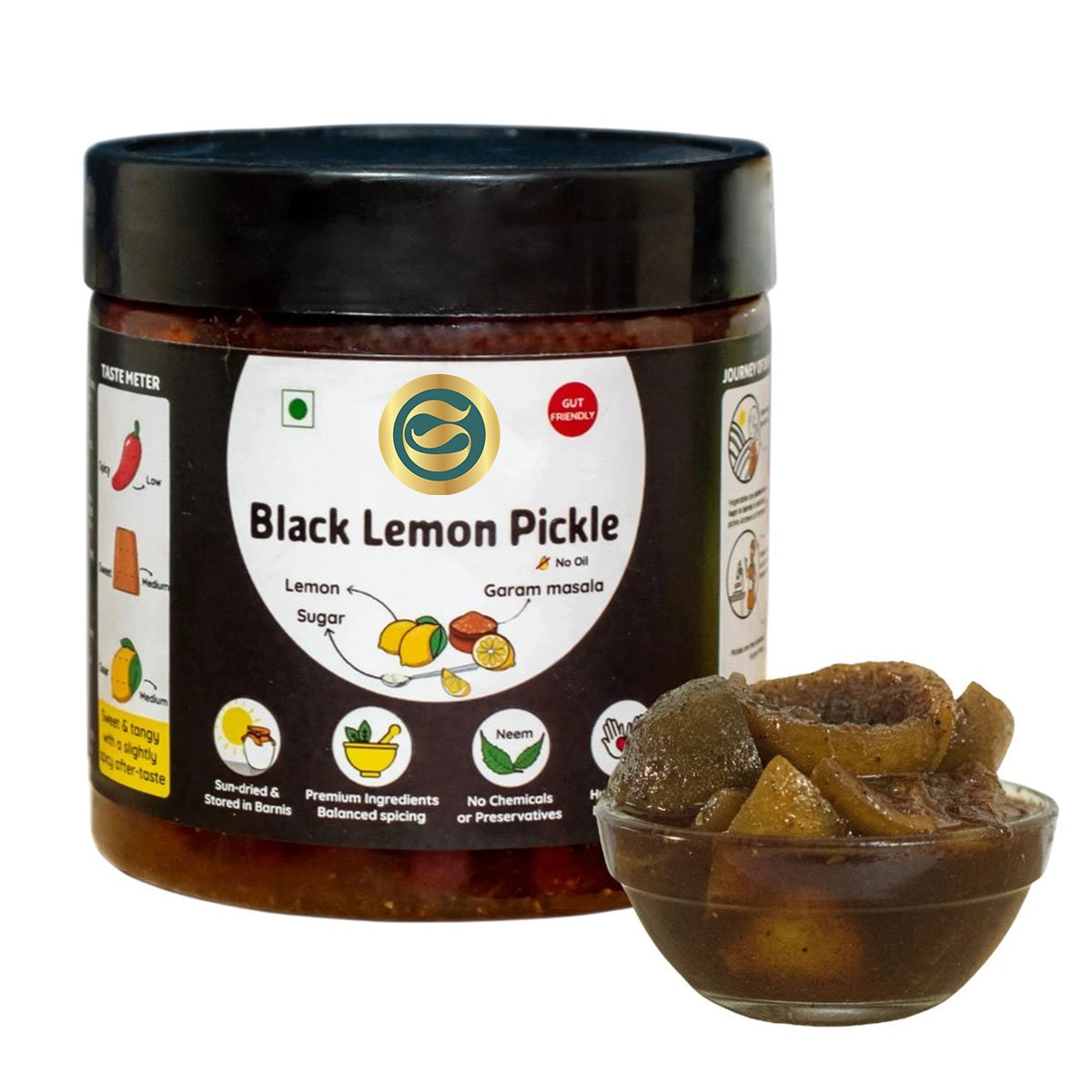



Table of Contents
- What Is Doodh Laddu Sweet? Understanding India’s Milk Ladoo
- The Cultural Story of Doodh Ke Laddu in Rajasthan
- What Makes Authentic Doodh Laddu Different from Regular Ladoo?
- Doodh Laddu Sweet Ingredients: The Power of Pure Milk
- Doodh Laddu Nutrition: Calories, Protein, and Real Health Value
- Doodh Laddu Sweet Price Guide: What Authentic Quality Costs
- How Govindam Makes the Best Doodh Ke Laddu in Jaipur
- How to Store Doodh Laddu Sweet: Freshness and Shelf Life
- Best Occasions to Gift or Serve Doodh Ke Laddu
- Frequently Asked Questions About Doodh Laddu Sweet
What Is Doodh Laddu Sweet? Understanding India’s Milk Ladoo
There are sweets that announce themselves loudly. And there are sweets that simply sit there, quiet and sure of themselves, knowing that anyone who tries them once will not forget.



Amla Chunda
Price range: ₹299.00 through ₹650.00
Amla Pickle
Price range: ₹299.00 through ₹650.00
Anardana Goli
Original price was: ₹200.00.₹150.00Current price is: ₹150.00.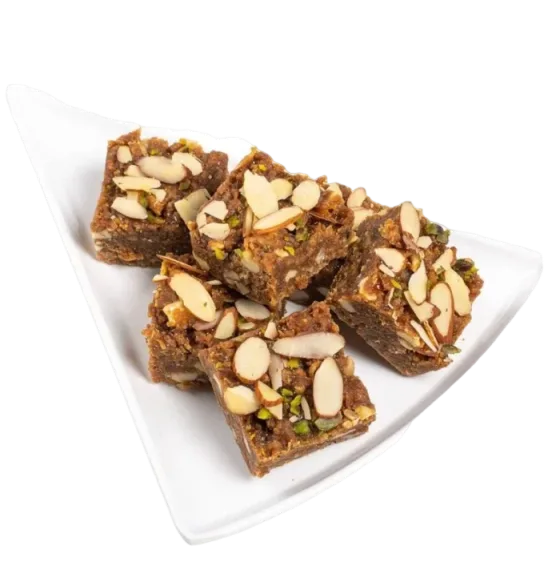
Authentic Dodha Barfi – Traditional Milk Sweet Delight
Original price was: ₹650.00.₹500.00Current price is: ₹500.00.
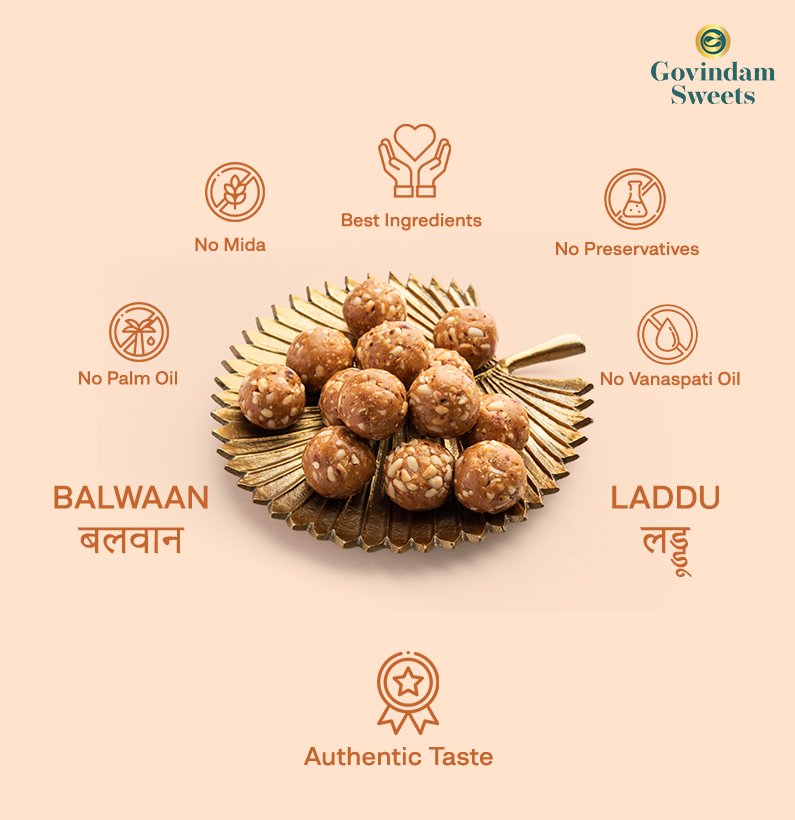
Balwan Laddu
Price range: ₹500.00 through ₹1,000.00
Besan Gatta
Original price was: ₹400.00.₹340.00Current price is: ₹340.00.
Besan Laddu
Price range: ₹270.00 through ₹540.00
Bikaneri Bhujia
Price range: ₹180.00 through ₹360.00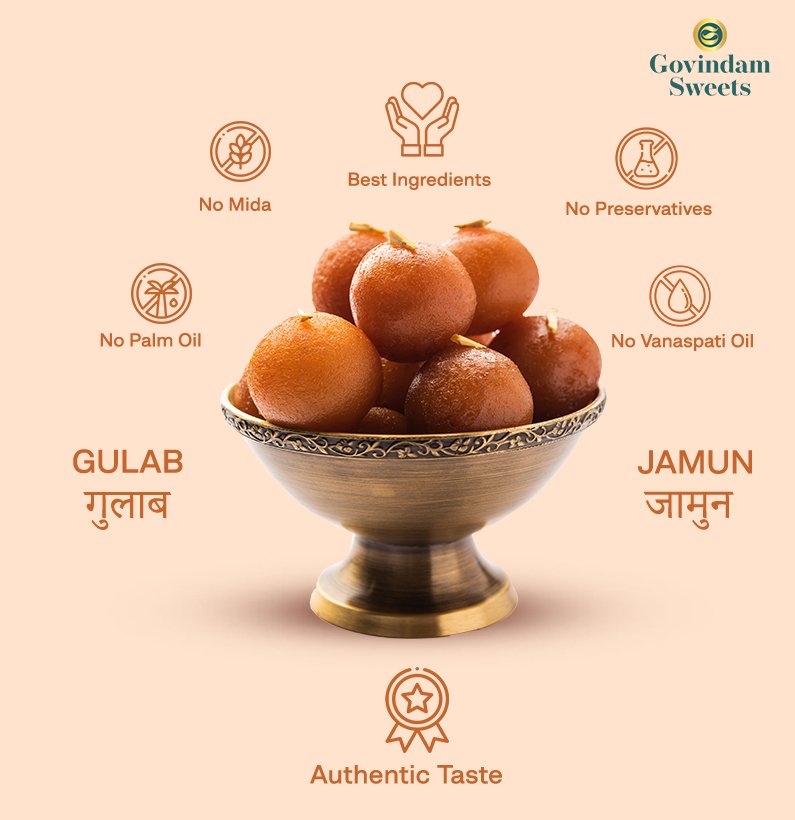
Black Gulab Jamun
Price range: ₹260.00 through ₹540.00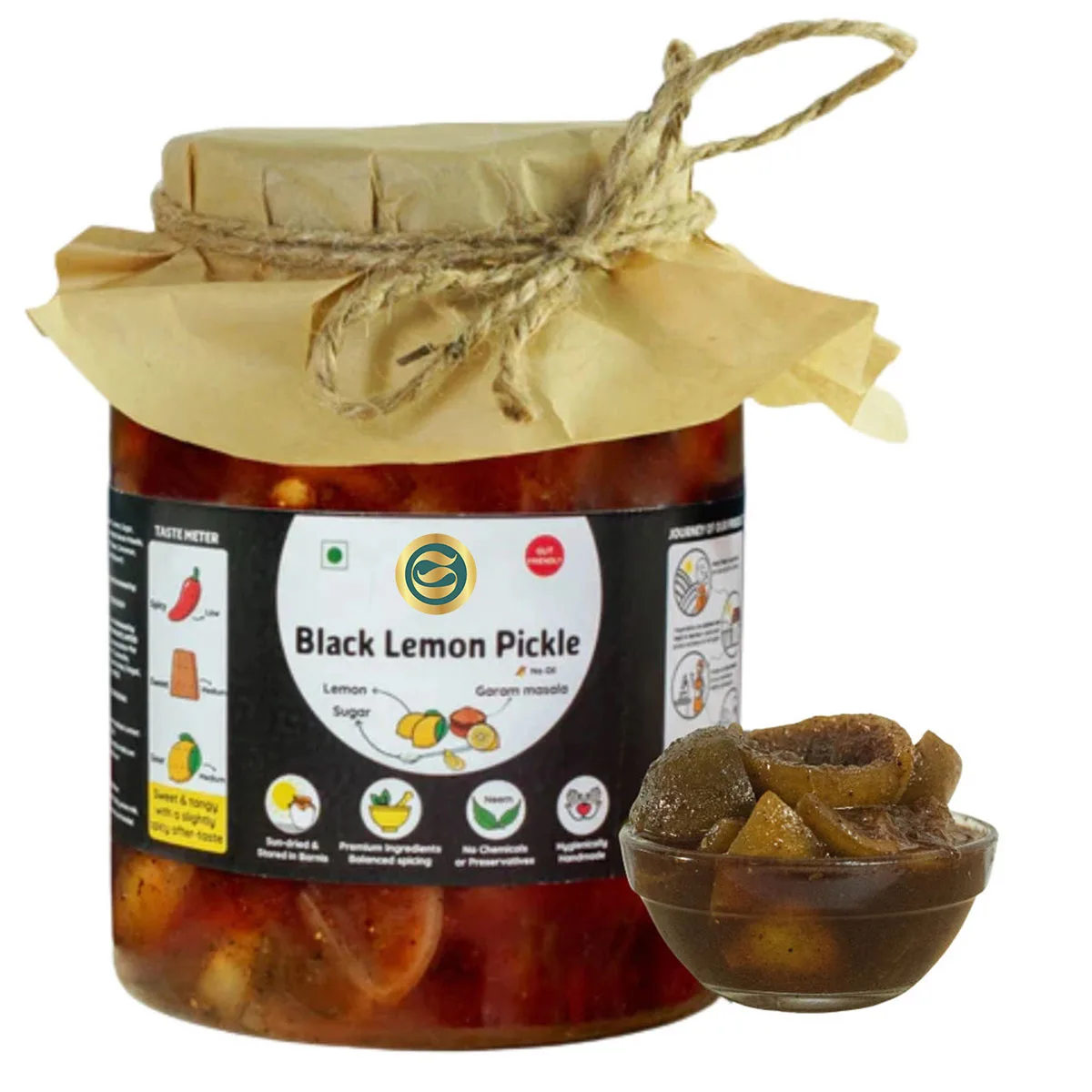
Black Lemon Pickle
Price range: ₹299.00 through ₹650.00Doodh laddu sweet is the second kind.
It does not have the visual spectacle of a ghewar or the silver-leaf elegance of kaju katli. What it has is something more fundamental — the deep, settled richness of milk that has been cooked slowly until it remembers what it is. Each ball is warm-looking and round, slightly irregular because it is shaped by hand, with a surface that carries the faint caramel note of reduced dairy. Pick one up and it is heavier than it looks. Take a bite and the texture is soft but substantial — giving way evenly, releasing cardamom and the clean sweetness of pure milk sugar.

Doodh laddu sweet, known across Rajasthan as doodh ke laddu, is made by reducing full-fat fresh milk over a slow flame until it becomes thick enough to hold a shape, then mixing it with ghee, sugar, and freshly ground cardamom, and rolling the warm mixture by hand into balls before it sets. No flour. No binding agent. No starch. The milk does all the work — which is exactly why the quality of the milk determines everything about the final product.
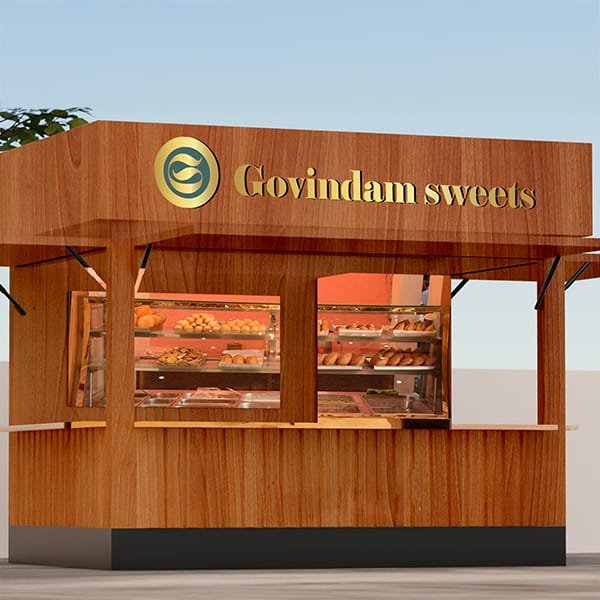
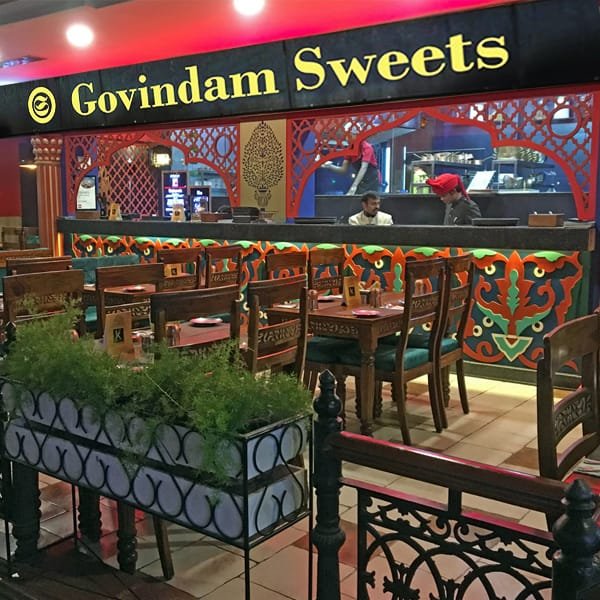
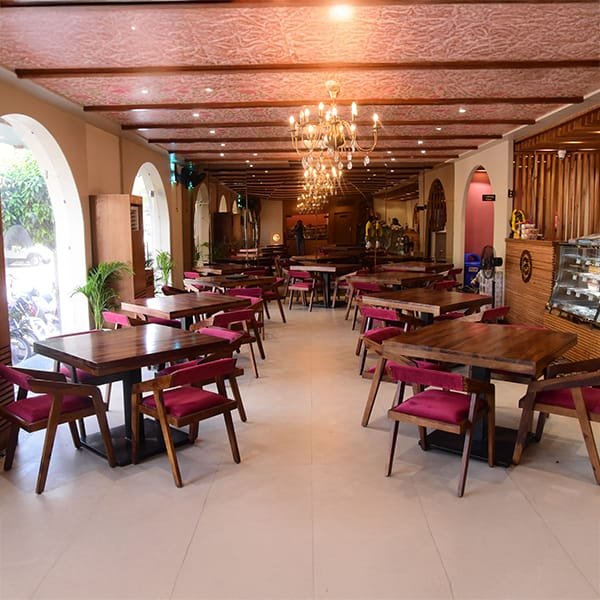
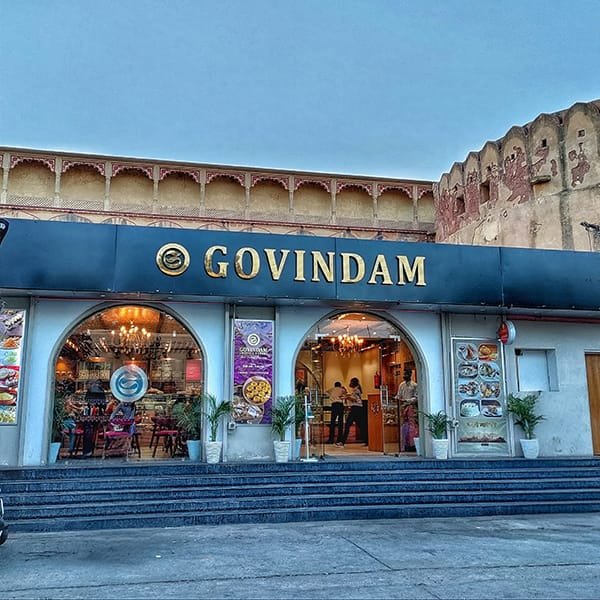
At Govindam Sweets, located near Govind Dev Ji Temple, Gangori Bazaar, J.D.A. Market, Pink City, Jaipur, Rajasthan 302003, we have been making authentic doodh laddu sweet since 1985. The recipe has remained unchanged. The milk is sourced fresh every morning. And the karigar who shapes each laddu by hand has been doing exactly this at our kitchen for nineteen years. Nothing about that process has been automated, scaled, or simplified. Browse our complete sweets collection to see everything we make with the same standard.
The Cultural Story of Doodh Ke Laddu in Rajasthan
Doodh ke laddu occupies a specific and deeply personal place in Rajasthani food culture — one that most people outside the state do not fully appreciate until someone from Rajasthan explains it to them.
In Rajasthan, doodh laddu sweet is not primarily a festive sweet. It is a sustenance sweet. A nourishment sweet. The kind that mothers make for daughters recovering from childbirth, that families prepare for children before examinations, that elderly grandmothers keep in a steel dabba and press into the hands of visiting grandchildren without ceremony or explanation. It is given, not presented. It is consumed quietly, not celebrated.
This distinction matters. Most Indian sweets exist in the context of celebration — they mark occasions, signal festivities, communicate generosity. Doodh ke laddu communicates something different. It communicates care. The hours of stirring that go into reducing the milk are not performed for a festival audience. They are performed because someone believes the person eating the laddu deserves that effort.
The practice of making doodh laddu sweet for new mothers is particularly deep-rooted in Rajasthani tradition. The milk solids provide substantial protein and fat for recovery and nursing. The ghee contributes essential fatty acids. The cardamom aids digestion, which is often compromised in the weeks following childbirth. Traditional Rajasthani midwives and family elders understood this nutritional logic intuitively, centuries before the language of modern nutrition existed to describe it.
At Govindam near Govind Dev Ji Temple, Jaipur, we receive orders for doodh laddu sweet year-round specifically for this purpose — new mothers, recovering patients, children who need nutritional supplementation, elderly customers who want a gentle, dairy-rich sweet they can eat without discomfort. That sustained demand outside the festival calendar is what distinguishes doodh ke laddu from most other mithai.
What Makes Authentic Doodh Laddu Different from Regular Ladoo?
People who have not eaten a properly made doodh laddu sweet often assume ladoo is ladoo. It is not. The differences between genuine doodh ke laddu and the various substitutes available under similar names are significant enough to affect both the taste experience and the nutritional profile entirely.
The most important distinction is the base ingredient. Boondi ladoo — the most common ladoo in India — is made from chickpea flour fried into tiny balls and soaked in sugar syrup. Besan ladoo is made from roasted chickpea flour and ghee. Motichur ladoo is a refined version of boondi. None of these have anything to do with milk. Doodh laddu sweet, by contrast, is made entirely from reduced fresh milk — which means its nutritional profile, its taste, and its texture are completely different from all flour-based ladoo variants.
The texture difference is immediately apparent. Flour-based ladoos have a granular, slightly dry texture that can feel chalky if over-roasted. Authentic doodh ke laddu is softer, denser, and more homogeneous — it gives evenly when bitten, without the grainy resistance of flour. It dissolves on the tongue with a lingering dairy sweetness rather than a starchy one.
The taste difference follows from the texture. Boondi ladoo tastes primarily of fried chickpea flour, sugar syrup, and rose water. Doodh laddu sweet tastes of milk — specifically the caramelised, concentrated version of milk that emerges from hours of patient reduction. That flavour is uniquely dairy and uniquely comforting in a way that no flour-based substitute can replicate.
The shelf life difference is also worth understanding. Flour-based ladoos last 2 to 3 weeks at room temperature because the dry flour base resists microbial growth. Authentic doodh ke laddu lasts 5 to 7 days refrigerated because its high moisture and dairy content make it perishable. A doodh laddu sweet that claims to last three weeks at room temperature is not made from fresh reduced milk. This matters when you are buying online and need to understand what you are actually receiving. Explore our ladoo collection to see the full range we make at Govindam.
Doodh Laddu Sweet Ingredients: The Power of Pure Milk
The doodh laddu sweet at Govindam is made from four ingredients. That is the complete list. Four ingredients, handled with precision, produce a result that no industrial shortcut can replicate.
Full-fat fresh milk is the defining ingredient. Not standardised milk with adjusted fat content. Not reconstituted milk from powder. Full-fat raw milk from Rajasthani dairy cooperatives, collected before 4 AM and delivered to our kitchen near Govind Dev Ji Temple, Gangori Bazaar by 5 AM. The fat content of our milk averages 6 to 7 percent — significantly higher than commercial standardised milk at 3 percent — and this fat content is what allows the reduced milk to hold a ball shape without any binder.
Pure desi ghee is the second ingredient. Added to the reducing milk during the final stage of cooking, the ghee serves two purposes simultaneously. It prevents the milk solids from scorching on the base of the vessel as they thicken, and it contributes the rich, buttery depth of flavour that sets a well-made doodh laddu sweet apart from a plain reduced-milk product. At Govindam, the ghee is clarified in-house daily from fresh butter sourced from the same cooperative as our milk.
Pure cane sugar is added at a precise moment in the cooking process — after the milk has reduced sufficiently that the addition of sugar will not cause excessive crystallisation, but early enough that the sugar integrates fully into the milk mass rather than sitting as separate crystals. The sugar level in our doodh ke laddu is deliberately moderate — enough to sweeten without masking the natural dairy flavour that is the entire point of this mithai.
Green cardamom, freshly ground each morning for that day’s production, is the aromatic finish. The quantity is measured carefully — cardamom should accent the milk flavour, not dominate it. A doodh laddu sweet that tastes primarily of cardamom has been over-seasoned. The milk should remain the lead note throughout.
No flour. No starch. No binding agent. No preservative. No artificial flavour. The four ingredients listed are the complete formula, and the shelf life reflects that honesty.
Doodh Laddu Nutrition: Calories, Protein, and Real Health Value
Doodh laddu sweet has one of the most genuinely nutritious profiles of any traditional Indian mithai — and this is not marketing language. It is a direct consequence of the ingredient composition.
| Nutrient | Per 100g Govindam Doodh Laddu | Notes |
|---|---|---|
| Calories | 380 to 420 kcal | Dense from milk fat and sugar |
| Protein | 10 to 14 grams | Significantly higher than flour-based ladoos |
| Total Fat | 18 to 22 grams | Primarily from dairy milk and desi ghee |
| Saturated Fat | 12 to 16 grams | From dairy sources, no trans fats |
| Carbohydrates | 40 to 46 grams | From milk lactose and added cane sugar |
| Calcium | 300 to 360 mg | Approximately 30 to 36% of daily adult requirement |
| Phosphorus | 200 to 240 mg | Supports bone and dental health |
| Vitamin A | 180 to 220 IU | From full-fat milk and desi ghee |
| Trans Fat | 0 grams | No hydrogenated fat used |
| Artificial Additives | None | No preservatives, colours, or flavours |
The protein content — 10 to 14 grams per 100 grams — is what distinguishes doodh laddu sweet nutritionally from the rest of the ladoo category. Boondi ladoo, for comparison, provides approximately 4 to 6 grams of protein per 100 grams, primarily from chickpea flour. Motichur ladoo provides a similar low-protein profile. Doodh ke laddu, because it is made from concentrated milk solids, provides two to three times the protein of any flour-based alternative.
The calcium content is equally significant. Full-fat milk reduced to the concentration required for doodh laddu sweet retains substantially all its calcium. At 300 to 360 mg per 100 grams, a serving of two medium ladoos provides approximately 60 to 70 percent of the daily calcium requirement for an adult — a genuinely meaningful contribution that explains the traditional practice of feeding doodh ke laddu to new mothers, growing children, and the elderly.
A standard serving of two medium doodh laddu sweet pieces weighs approximately 60 to 70 grams total, providing 230 to 300 calories. This is a satisfying, nourishing quantity that supports the traditional use of this mithai as a morning or afternoon sustenance food rather than merely a post-meal indulgence.
Doodh Laddu Sweet Price Guide: What Authentic Quality Costs
Understanding the price structure of doodh laddu sweet helps distinguish genuine product from commercial imitations sold under similar names.
| Format | Price Range | Notes |
|---|---|---|
| 250g standard sweet shop | Rs 150 to 250 | Quality entirely depends on milk type used |
| 500g mid-range branded | Rs 280 to 450 | Check if fresh milk or powder is specified |
| 500g premium fresh-made | Rs 420 to 580 | Govindam and equivalent quality producers |
| 1kg bulk order | Rs 800 to 1100 | For gifting, new mother care, or large families |
| Online delivery pan-India | Rs 480 to 680 per 500g | Cold-chain packaging included in price |
| Festival gift box | Rs 650 to 1200 | Presentation packaging with personalised message |
The doodh laddu sweet price at Govindam reflects the actual cost of farm-fresh full-fat milk — which costs significantly more than reconstituted or standardised milk — plus the time cost of two to three hours of continuous reduction per batch. A 500g box of genuine doodh ke laddu made from farm-fresh milk cannot be produced and sold at Rs 200. If you see it priced there, you are not looking at fresh-milk product.
For bulk orders above 2kg — commonly requested for new mother care, wedding favours, and corporate gifting — contact Govindam directly at +91-7976304072 or email info@govindam.co.in. Orders above Rs 4000 receive a 20 percent discount automatically at checkout on our online shop.
How Govindam Makes the Best Doodh Ke Laddu in Jaipur
Four AM. The kitchen near Govind Dev Ji Temple, Gangori Bazaar is already warm from the first flames under the heavy-bottomed vessels. The milk has been delivered. The ghee is ready. And the karigar who shapes every doodh laddu sweet at Govindam has already been at his station for thirty minutes.
This is not theatre. This is the production reality of making genuine doodh ke laddu — a sweet that demands continuous attention from the moment the milk goes on the flame to the moment the last laddu is shaped and set aside to cool.
The reduction process takes between two and three hours per batch, depending on the initial fat content of that morning’s milk delivery. The karigar stirs continuously — never stopping, never leaving the flame unattended, adjusting the heat by sense rather than thermometer because he has done this enough times that the sight and sound of the reducing milk tells him everything he needs to know. The smell changes as the milk thickens. The colour deepens from white to cream to pale gold. The texture shifts from liquid to thick paste to the semi-solid consistency that, when a small amount is rolled between the palms, holds its shape without crumbling or sticking.
That is the moment. Too early and the doodh laddu sweet falls apart. Too late and it becomes too firm to shape at all. The window is perhaps ten minutes. The karigar knows when it has arrived.
At Govindam, we produce doodh ke laddu in controlled batches — never scaling up production at the cost of this precision. Our product page at Govindam Special Doodh Laddu reflects the daily batch system: when a day’s production is sold out, it is sold out. We do not substitute refrigerated carry-over stock or extend batches with additional powder.
The result is a doodh laddu sweet that tastes the way it should. Not approximately correct. Exactly correct. And that precision is available for delivery anywhere in India through our cold-chain shipping network — each laddu packed individually to prevent breakage, each box packed in insulated material to maintain temperature through 48 to 72 hours of transit. Check our Rajasthani Special collection for other traditional Rajasthani sweets made with the same discipline.
How to Store Doodh Laddu Sweet: Freshness and Shelf Life
Authentic doodh laddu sweet made from fresh milk has a refrigerated shelf life of 5 to 7 days. This is shorter than flour-based ladoos and that is exactly as it should be — the high dairy content that makes doodh ke laddu so nutritionally rich is the same property that makes it perishable.
Refrigerate immediately on receipt. Place the doodh laddu sweet in an airtight container — the original packaging if it is airtight, or a clean steel or glass container. Keep it on a middle or upper shelf, away from strongly aromatic items. Dairy sweets absorb odours quickly. Do not store next to pickles, cut onions, or strong-smelling produce.
At room temperature in cool weather — under 20 degrees Celsius — doodh ke laddu can be kept for 24 to 36 hours safely. In Rajasthan’s summer months and across most of India’s warm seasons, refrigeration from the moment of receipt is not optional. Room-temperature storage during warm weather will spoil the laddu within 12 to 16 hours.
Do not freeze doodh laddu sweet. The milk protein emulsion in reduced milk solids breaks on freezing and produces a grainy, wet crumble on thawing that is unpleasant and bears no resemblance to the original texture. Freezing is a common mistake with dairy-based mithai and it consistently destroys the product.
All Govindam orders include a clearly printed manufacture date and best-before date on the outer packaging. Our cold-chain packaging is rated for 48 to 72 hours of temperature maintenance without external refrigeration — sufficient for standard pan-India transit times.
Best Occasions to Gift or Serve Doodh Ke Laddu
Doodh laddu sweet is not a sweet that waits for a festival. That is what makes it different from almost everything else in the mithai category.
New mother care is the most traditional and deeply meaningful use. In Rajasthani culture, new mothers are traditionally given doodh ke laddu daily for the first 40 days postpartum — a practice grounded in the understanding that the concentrated milk solids, ghee, and cardamom support recovery, enhance milk production for nursing, and provide the caloric density that the postpartum body genuinely needs. Govindam receives orders for this purpose year-round, often from families who have maintained this tradition for generations and need an authentic, preservative-free product they can trust.
Recovery and convalescence is the second traditional context. Patients recovering from illness, surgery, or extended physical effort benefit from the high-protein, high-calcium nutritional profile of doodh laddu sweet in a form that is easy to eat, easy to digest, and genuinely palatable without appetite.
Diwali and festive gifting works naturally for doodh ke laddu because of its visual appeal — the round, smooth balls in a gift box look beautiful and communicate care. Our festival collection includes doodh laddu sweet in curated festive boxes alongside complementary mithai.
Children’s nutrition boxes are a growing category at Govindam. Parents who want to provide their children with a high-protein, high-calcium alternative to processed packaged snacks order doodh ke laddu specifically for this purpose. Two medium ladoos as an after-school snack deliver more protein and calcium than most commercially available health bars.
Corporate wellness gifting is another strong use case. The health-forward positioning of doodh laddu sweet — genuine dairy nutrition, no artificial additives, traditional preparation — resonates with corporate gifting programmes that want to move away from chocolate boxes and generic sweets. See our gifts section for corporate gift options that include doodh ke laddu.
Frequently Asked Questions About Doodh Laddu Sweet
Q1. What is doodh laddu sweet made from?
Doodh laddu sweet is made from four ingredients: full-fat fresh milk, pure desi ghee, pure cane sugar, and freshly ground green cardamom. No flour, no starch, no binding agent, no preservative, and no artificial flavour. The milk is reduced over a slow flame for two to three hours until it reaches the exact consistency that allows it to be rolled into balls by hand without any additional binder.
Q2. How is doodh ke laddu different from boondi ladoo or besan ladoo?
The fundamental difference is the base ingredient. Boondi ladoo and besan ladoo are made from chickpea flour — they are gram-flour sweets. Doodh laddu sweet is made entirely from reduced fresh milk — it is a dairy sweet. The texture, taste, nutritional profile, and shelf life are completely different. Doodh ke laddu provides significantly more protein, calcium, and fat from dairy than any flour-based ladoo variant.
Q3. Is doodh laddu sweet good for new mothers?
Yes, doodh ke laddu has been traditionally given to new mothers in Rajasthan for generations, and the nutritional logic is sound. The concentrated milk solids provide protein and calcium that support postpartum recovery and nursing. The desi ghee provides essential fatty acids. The cardamom aids digestion. Govindam makes doodh laddu sweet without any preservatives or artificial additives, making it safe for new mothers and nursing infants who may be sensitive to synthetic ingredients.
Q4. How long does doodh laddu sweet stay fresh?
Refrigerated in an airtight container, authentic doodh ke laddu stays fresh for 5 to 7 days. At room temperature in cool weather under 20 degrees Celsius, it can be kept safely for 24 to 36 hours. Do not freeze doodh laddu sweet — freezing breaks the milk protein structure and destroys the texture on thawing. All Govindam orders include a printed best-before date and are packed in cold-chain packaging rated for 48 to 72 hours of transit.
Q5. Can I order doodh laddu sweet online with delivery outside Jaipur?
Absolutely. Govindam ships doodh ke laddu pan-India in insulated cold-chain packaging designed to maintain freshness through 48 to 72 hours of standard transit. We also ship internationally to the UK, USA, UAE, Canada, Singapore, and Australia. For international orders, we recommend our vacuum-packed doodh laddu variant with an extended shelf life. Check our global shipping page for details or call +91-7976304072.
Q6. What is the best way to consume doodh ke laddu for nutritional benefit?
Consume doodh laddu sweet at room temperature — remove from the refrigerator 20 to 30 minutes before eating. Cold dairy sweets lose some of their aroma and the texture becomes firmer than ideal. For nutritional use — such as postpartum recovery or children’s supplementation — two medium ladoos in the morning, eaten with a glass of warm milk, provides a complete high-protein, high-calcium start to the day without processed additives.
Q7. Does Govindam make doodh laddu sweet without sugar for diabetics?
Yes. Govindam produces a sugar-free doodh ke laddu variant made with stevia — available on request for customers managing blood sugar. The sugar-free variant maintains the same fresh-milk base, pure ghee, and fresh cardamom as the standard product. Call +91-7976304072 or write to info@govindam.co.in to enquire about availability and current pricing for the sugar-free range.
Visit or Contact Govindam Sweets
Govindam Sweets has been making authentic doodh laddu sweet and traditional Rajasthani mithai from one address since 1985.
Near Govind Dev Ji Temple, Gangori Bazaar, J.D.A. Market, Pink City, Jaipur, Rajasthan 302003
Phone and WhatsApp: +91-7976304072
Email: info@govindam.co.in
Website: https://www.govindam.co.in/
Pan-India delivery is available on all orders with cold-chain packaging. Orders above Rs 4000 receive a 20 percent discount automatically at checkout. Same-day delivery within Jaipur city limits is available for orders placed before 11 AM. International shipping is available — check the global shipping page for your country.
Shop Doodh Laddu Now — Explore Ladoo Collection — View All Gift Options
