Posts
Soan Papdi Sweet — India’s Most Complete Festival Mithai Guide 2026

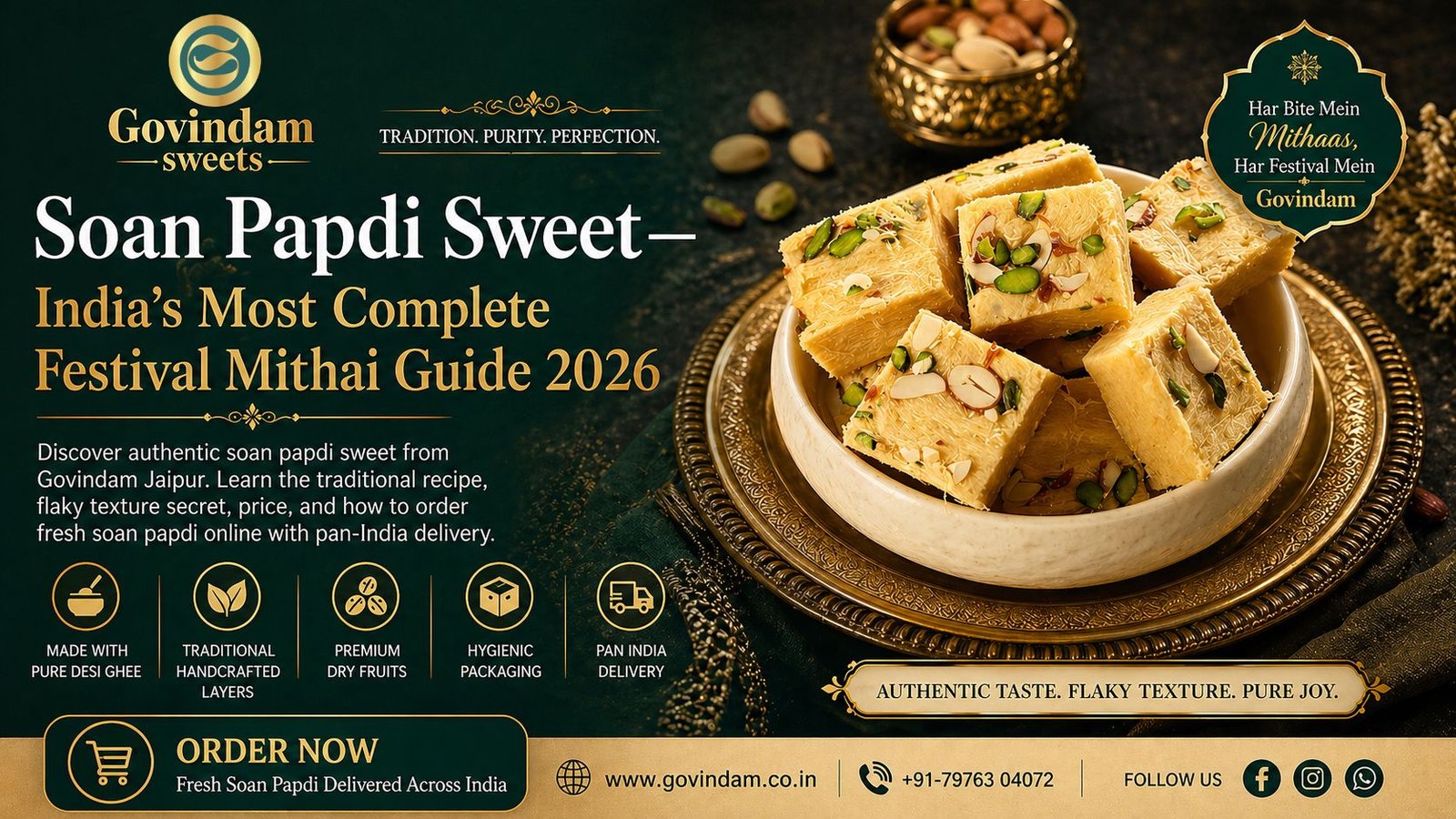
Soan papdi sweet is India’s most universally gifted festival mithai — a cloud-like confection of thousands of paper-thin besan and ghee strands compressed into a square that shatters into a melt-on-tongue floss at first bite. Govindam Sweets Jaipur has crafted authentic soan papri since 1985. Order online with pan-India delivery and 100% freshness guarantee.
Soan Papdi Sweet — India’s Most Trusted Festival Flaky Mithai
By Govindam Sweets | Master Confectioners | Near Govind Dev Ji Temple, Gangori Bazaar, Jaipur | FSSAI Certified | Est. 1985 Published: April 2026 | Reading Time: 12 Minutes

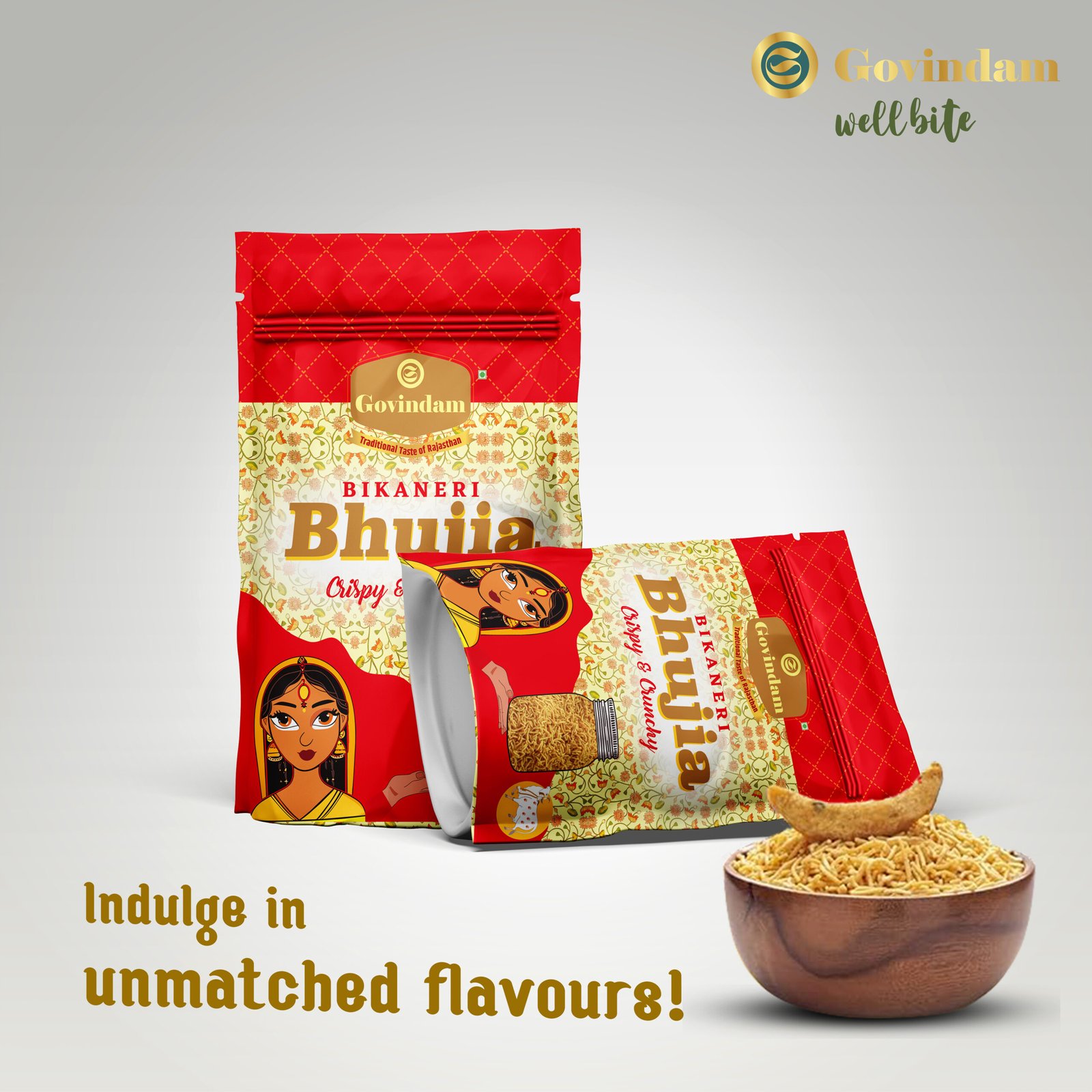
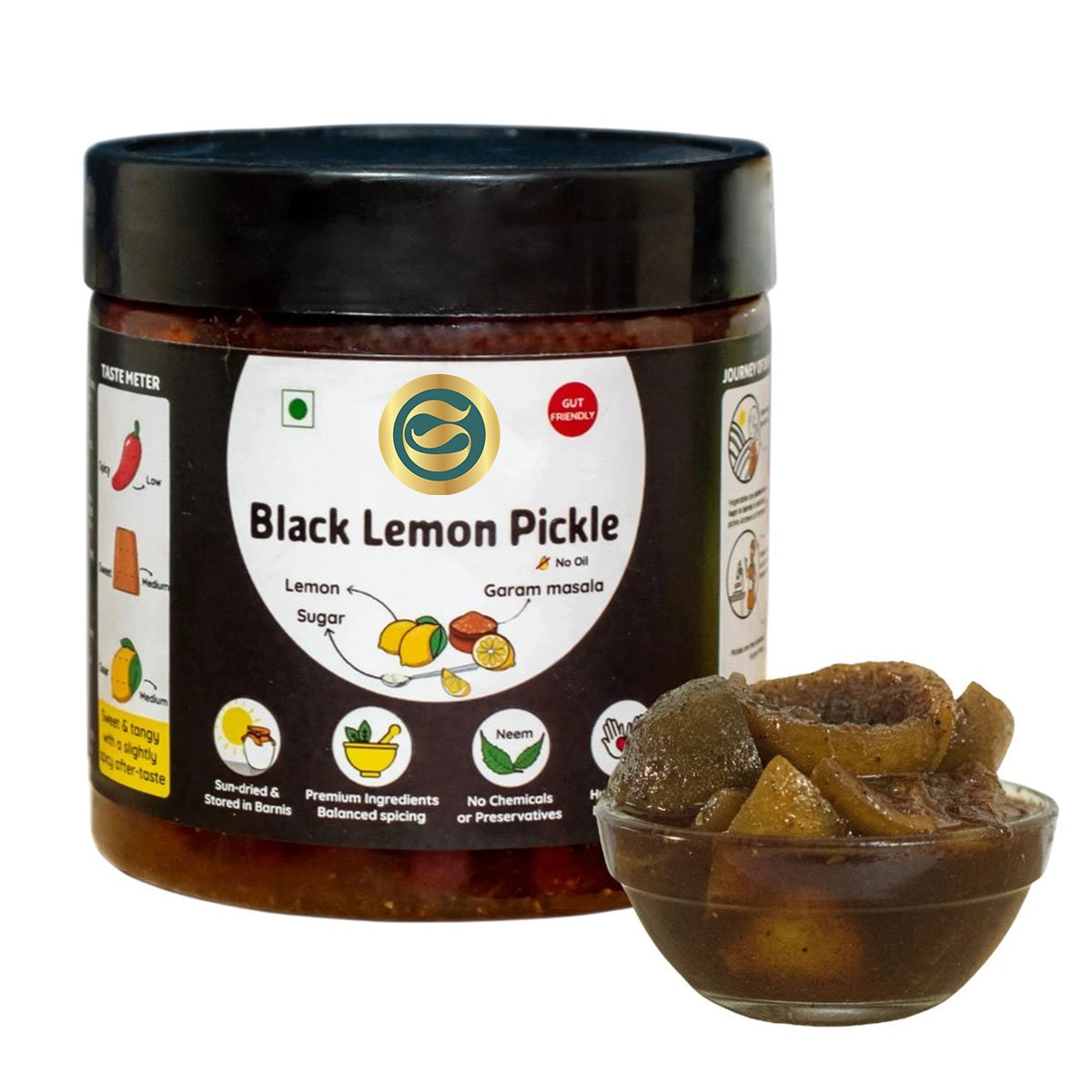



Table of Contents
- What Is Soan Papdi Sweet? India’s Most Misunderstood Festival Mithai
- The History of Soan Papdi: How a Flaky Sweet Became a National Icon
- Soan Papdi vs Patisa: Understanding the Real Difference
- What Goes into Authentic Soan Papdi: Ingredients and the Pulling Process
- Soan Papdi Sweet Nutrition: Calories and What You Should Know
- Soan Papdi Sweet Price Guide: What Quality Looks Like
- How Govindam Jaipur Makes the Best Soan Papdi Sweet in India
- Chocolate Soan Papdi: The Contemporary Variant Explained
- How to Store Soan Papdi Sweet: Shelf Life and Freshness Tips
- Frequently Asked Questions About Soan Papdi Sweet
What Is Soan Papdi Sweet? India’s Most Misunderstood Festival Mithai
Every Diwali in India, a conversation happens. Somewhere in a living room, someone opens a gift box, finds the gold-foil wrapped square, and says — with varying degrees of affection — oh, soan papdi again. And then eats three pieces without pausing.



Amla Chunda
Price range: ₹299.00 through ₹650.00
Amla Pickle
Price range: ₹299.00 through ₹650.00
Anardana Goli
Original price was: ₹200.00.₹150.00Current price is: ₹150.00.
Authentic Dodha Barfi – Traditional Milk Sweet Delight
Original price was: ₹650.00.₹500.00Current price is: ₹500.00.
Balwan Laddu
Price range: ₹500.00 through ₹1,000.00
Besan Gatta
Original price was: ₹400.00.₹340.00Current price is: ₹340.00.
Besan Laddu
Price range: ₹270.00 through ₹540.00
Bikaneri Bhujia
Price range: ₹180.00 through ₹360.00
Black Gulab Jamun
Price range: ₹260.00 through ₹540.00
Black Lemon Pickle
Price range: ₹299.00 through ₹650.00This is soan papdi sweet’s peculiar cultural status. It is simultaneously the most gifted Indian festival sweet and the sweet that people most regularly claim not to need more of. It is mocked affectionately by an entire generation of social media users and eaten immediately, every single time, by the same people doing the mocking.
There is a reason for both things. The reason soan papdi sweet gets gifted so persistently is that it is genuinely excellent — universally liked, long shelf life, good price-to-volume ratio, and visually clean in its gold packaging. The reason people joke about receiving it is that they receive so much of it during Diwali that it becomes a running gag. Neither of these facts cancels the other.

What most people who make these jokes do not know is that a properly made soan papdi sweet — made with real besan, real ghee, pulled to thousands of fine strands rather than pressed into a uniform block — is one of the most technically sophisticated confections in the Indian mithai tradition. The texture that makes it melt immediately on the tongue is not an accident. It is the result of a specific, demanding process that requires experienced hands, exact temperature management, and years of practice to execute consistently.
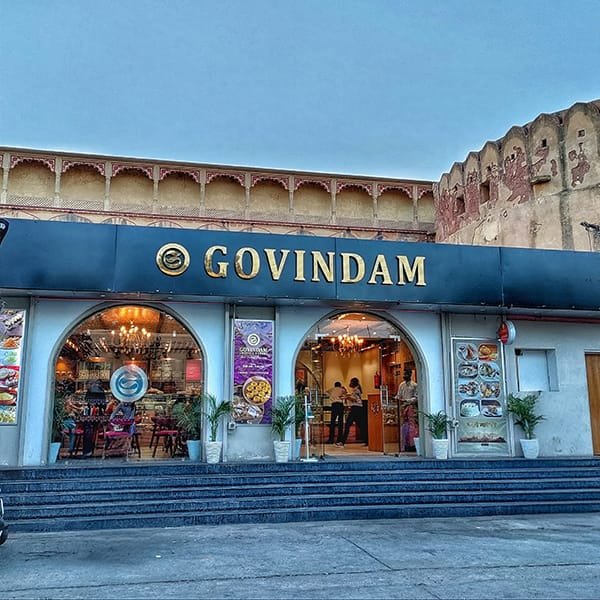
At Govindam Sweets, near Govind Dev Ji Temple, Gangori Bazaar, J.D.A. Market, Pink City, Jaipur, Rajasthan 302003, we have been making authentic soan papdi sweet since 1985. Ours does not taste like the mass-produced version that most people associate with the name. Browse our complete sweets collection to understand the difference.
The History of Soan Papdi: How a Flaky Sweet Became a National Icon
Soan papdi sweet belongs to a family of pulled-and-flaked sweets that appears across a wide geographical arc stretching from Turkey through Iran, Afghanistan, Pakistan, and into North India. The common thread across all these traditions is a process of cooking sugar or honey with a starch base to a specific temperature, then pulling and folding the hot mixture repeatedly until it transforms from a dense, sticky mass into thousands of fine, crystalline strands that can be compressed into blocks or formed into other shapes.
In Turkey, this tradition produces the sweet called pişmaniye. In Iran, it produces pashmak. In Afghanistan and Pakistan, it produces sohan halwa — a dense, chewy confection that shares DNA with soan papdi sweet but is considerably heavier and less flaky. The Indian tradition — which arrived through the trade and culinary exchange of the Mughal period — refined the technique further, incorporating besan as a structural element and developing the specific pulling method that produces the thread structure characteristic of soan papdi sweet.
The name itself is composite — soan is believed to derive from the Persian word for gold, referencing the pale golden colour of the finished sweet, and papdi from the Sanskrit and Hindi word for thin layer or flake. Together they describe the product precisely — a golden, flaky confection — without any marketing embellishment.
By the 20th century, soan papdi sweet had become the dominant mass-market festival sweet in North India, primarily because it combined relatively low raw material cost with extremely high visual volume — a box of soan papdi appears generous in a way that a comparably priced box of kaju katli does not, because the flaked structure makes even a small quantity of sweet fill a large volume of space. This practical gift economy logic is partly what made soan papdi the Diwali staple it became. According to market research published by the Indian Confectionery Manufacturers Association, soan papdi accounts for approximately 18 to 22 percent of the organised Indian mithai gifting market by value during the October to November Diwali season. That is an extraordinary share for a single product.
Soan Papdi vs Patisa: Understanding the Real Difference
This distinction confuses people regularly, and the confusion is understandable because the two sweets share ingredients and a similar visual appearance at first glance. They are, however, produced by fundamentally different techniques and have significantly different textures.
Soan papdi sweet is made by cooking a besan and sugar syrup mixture to a specific temperature, then pulling it rapidly in a process similar to gajak pulling — stretching and folding the hot mixture to create thousands of fine strands. These strands are then layered, compressed lightly into blocks, and cut into squares. The texture of properly made soan papdi is aeriated, strand-based, and dissolves almost instantly on the tongue because the fine filaments have enormous surface area relative to their mass.
Patisa is produced differently. The cooked besan-ghee mixture for patisa is spread thin on a surface and allowed to set into solid layers rather than being pulled into strands. The result is a hard, thin, crispy sheet — more like a brittle than a floss. Patisa shatters when bitten rather than melting. It is more intensely flavoured and less immediately sweet than soan papdi sweet because the denser structure delivers flavour more slowly as it breaks down.
Soan papdi sweet is lighter, airier, and dissolves faster. Patisa is crisper, denser, and has a more pronounced ghee-and-besan flavour because it is less aerated. Both are genuine traditional products with distinct pleasures. At Govindam, we make both — our fresh patisa product represents the Jodhpur-style crispy variant, while soan papdi sweet represents the pulled-strand tradition.
A word on sohan halwa — a third related sweet that causes confusion. Sohan halwa is a dense, chewy confection from UP and Pakistan, made primarily from wheat starch, ghee, and sugar with no besan component. The texture is completely different from both soan papdi and patisa — firm, fudgy, and significantly heavier. Our sohan halwa product is available separately for customers specifically seeking this tradition.
What Goes into Authentic Soan Papdi: Ingredients and the Pulling Process
The ingredient list for soan papdi sweet looks simple. The execution is not.
Besan — fine chickpea flour — is the primary structural ingredient. At Govindam, we use double-sifted fine besan from verified suppliers, the same standard we apply across all besan-based preparations. The quality of the besan affects both the flavour of the roasted mixture and the behaviour of the pulled strands — coarser besan produces thicker, less uniform strands that dissolve more slowly.
Pure desi ghee is both a flavour carrier and a functional ingredient in the pulling process. Ghee coats the developing strands during pulling and prevents them from sticking to each other and collapsing back into a solid mass. Without sufficient ghee, the strands fuse on contact and the texture is lost. With too much, the finished soan papdi sweet is greasy rather than light. The correct quantity is a production parameter that every experienced karigar knows by feel.
Pure cane sugar is cooked with water to the hard-crack temperature — approximately 150 to 155 degrees Celsius — which is the specific temperature that produces the crystalline structure needed for proper strand formation. Below this temperature, the pulled mixture remains sticky rather than crystallising into strands. Above it, the sugar burns and the mixture becomes bitter and brittle.
Cardamom — freshly ground at our kitchen near Govind Dev Ji Temple — provides the aromatic accent. The quantity in soan papdi sweet is minimal — less than in besan ladoo or kaju katli — because the delicate floss structure dissipates aroma quickly and a heavy cardamom hand can overwhelm the light flavour profile of the sweet.
The pulling process itself is the critical technical step. When the cooked besan-ghee-sugar mixture is ready — poured onto a ghee-greased surface and cooled enough to handle but still hot and pliable — two karigars pull it simultaneously from opposite ends, fold it, rotate it 90 degrees, and pull again. This is repeated rapidly, dozens of times, as the mixture cools and the strands multiply and refine. Each pull doubles the strand count. After 15 to 20 pulls, the mixture contains thousands of fine strands barely visible to the naked eye. At this point the pulling stops, the mass is layered and compressed lightly, and cut into squares. The entire process from pour to cut takes approximately 10 to 15 minutes and cannot be paused.
Soan Papdi Sweet Nutrition: Calories and What You Should Know
Soan papdi sweet is a festival food and should be understood as one. The besan-ghee-sugar combination is calorie-dense. But the pulled-strand structure means that a visual serving of soan papdi sweet weighs significantly less than its apparent volume suggests — which makes portion management more intuitive than with denser sweets.
| Nutrient | Per 100g Govindam Soan Papdi | Notes |
|---|---|---|
| Calories | 440 to 480 kcal | Besan, ghee, and sugar base |
| Total Fat | 20 to 24 grams | Primarily from pure desi ghee |
| Saturated Fat | 12 to 15 grams | From dairy ghee, no trans fats |
| Carbohydrates | 58 to 66 grams | Predominantly from sugar and besan |
| Protein | 7 to 10 grams | From chickpea flour |
| Dietary Fibre | 2 to 3 grams | From chickpea flour |
| Iron | 2 to 3 mg | From chickpea flour |
| Trans Fat | 0 grams | No hydrogenated fat used |
| Artificial Colour | None | Natural pale gold from besan roasting |
| Artificial Flavour | None | Natural cardamom only |
A standard serving of soan papdi sweet — a single 25 to 30 gram square — provides approximately 110 to 145 calories. Two squares as a serving delivers 220 to 290 calories. Because the strand structure means the sweet breaks and dissolves so quickly in the mouth, it is subjectively satisfying from a small quantity in a way that denser sweets often are not — which is part of what makes it such a universally popular festival treat.
The soan papdi calories question is frequently searched — particularly by people who want to know how many pieces they can reasonably eat from a gift box without feeling guilty. The answer for Govindam’s product specifically is 110 to 145 calories per standard piece. One or two pieces is the traditional serving, which is entirely manageable within a normal festive caloric intake.
Soan Papdi Sweet Price Guide: What Quality Looks Like
Soan papdi sweet is one of the most price-variable products in Indian confectionery — the range between the cheapest commercial product and the finest artisanal version is wider than for almost any other mithai.
| Format | Price Range | Notes |
|---|---|---|
| 250g standard commercial | Rs 80 to 150 | Palm oil or vanaspati often used instead of ghee |
| 500g mid-range branded | Rs 180 to 300 | Check ingredient list for hydrogenated fat |
| 500g premium desi ghee | Rs 280 to 420 | Govindam and equivalent quality producers |
| 1kg bulk | Rs 520 to 780 | For corporate Diwali gifting or large families |
| Chocolate soan papdi 500g | Rs 320 to 480 | Chocolate-coated variant, premium positioning |
| Soan papdi gift box | Rs 450 to 1200 | Festival packaging with personalised card |
| Online delivery pan-India | Rs 320 to 550 per 500g | Cold-chain packaging included |
The soan papdi price difference between Rs 80 and Rs 420 per 500g reflects two fundamentally different products. The cheap version uses palm oil or hydrogenated vegetable fat instead of desi ghee — which produces a synthetic, slightly waxy texture and a flat flavour profile. The premium version uses pure desi ghee — which is why it costs more and why it tastes the way soan papdi sweet is supposed to taste.
For corporate Diwali orders above 50 units — our most common soan papdi category — contact Govindam at +91-7976304072 or email info@govindam.co.in. We provide branded packaging, personalised message cards, and pan-India co-ordinated delivery for corporate clients. Orders above Rs 4000 receive a 20 percent discount automatically at checkout on our online shop.
How Govindam Jaipur Makes the Best Soan Papdi Sweet in India
There is a commercial version of soan papdi sweet that most people in India have eaten — uniform, slightly stiff squares with a consistent texture that dissolves adequately and tastes of sugar more than anything else. It is produced at scale in automated or semi-automated facilities. The pulling, if it happens at all, is done by machine. The ghee, in most cases, is replaced partially or fully with palm oil. The result fills boxes and ships well. It is also not what soan papdi sweet is supposed to taste like.
At our kitchen near Govind Dev Ji Temple, Gangori Bazaar, Jaipur, the process for soan papdi sweet is entirely by hand. Our karigars are specifically trained in the pulling technique — a skill that requires both physical coordination and a precise understanding of the temperature window during which pulling is possible. Too cool and the mixture sets before sufficient strands have formed. Too warm and it sticks together during folding and will not strand properly.
The besan is roasted in pure desi ghee in a brass vessel until it reaches the deep golden-amber colour and hazelnut aroma that signals correct roasting. The sugar syrup is cooked separately to hard-crack temperature — checked by the cold-water test, not a thermometer, because our karigar’s judgment is more reliable than any instrument for a process he has performed thousands of times. The two components come together in the vessel for a final brief cook, then the mixture goes to the pulling surface.
Two karigars, side by side. Pulling, folding, rotating. Rapidly, because the window is narrow. After 12 to 15 pulls — which doubles the strand count each time, moving from a few dozen strands to thousands — the mass is pressed lightly, layered, and cut. The entire production from first pour to cut takes under 20 minutes per batch.
The result is a soan papdi sweet that dissolves on first tongue contact, carries the genuine flavour of roasted chickpea flour and real ghee rather than sugar and palm oil, and has the pale gold colour of natural roasting rather than artificial whitening. Our patisa product page and patisa barfi variant show the full range of flaked-sweet traditions we produce alongside soan papdi.
Chocolate Soan Papdi: The Contemporary Variant Explained
Chocolate soan papdi sweet has emerged as one of the fastest-growing contemporary mithai variants in India — a product that bridges traditional Indian confectionery with the universal appeal of chocolate in a way that genuinely works rather than feeling forced.
The preparation involves making standard soan papdi sweet using the traditional pulled-strand method, then either coating the finished squares in a layer of dark or milk chocolate, or incorporating cocoa powder into the besan mixture at the roasting stage to produce a chocolate-flavoured strand structure from the inside out.
The coating method produces a sweet where the chocolate exterior and the flaky sweet interior contrast pleasingly — the slight bitterness of good dark chocolate balancing the pure sweetness of the soan papdi and the two textures — smooth hard chocolate shell and airy sweet interior — creating a genuinely interesting eating experience.
The infusion method produces a more uniformly flavoured soan papdi sweet where chocolate is present in every strand. This version tends to be darker in colour — deep brown rather than golden — and carries a more consistent chocolate presence throughout.
Govindam produces chocolate soan papdi sweet as a seasonal variant, available year-round on request and as a standard product during Diwali season. It is positioned as a premium alternative to standard soan papdi and as an accessible entry point for customers who want to introduce younger family members or international recipients to Indian mithai through a familiar flavour bridge. Contact us at +91-7976304072 or info@govindam.co.in to enquire about current availability.
How to Store Soan Papdi Sweet: Shelf Life and Freshness Tips
Soan papdi sweet has an excellent shelf life compared to dairy-based or chenna-based mithai — a major practical advantage that directly contributes to its popularity as a Diwali gift.
At room temperature in an airtight container away from humidity and direct sunlight, soan papdi sweet stays fresh and maintains its characteristic flaky texture for 15 to 20 days. In low-humidity environments, up to 25 days. Refrigeration is generally not necessary for soan papdi sweet and is not recommended — refrigerator humidity can soften the strand structure and make the surface slightly sticky.
The critical storage rule is identical to gajak sweet — airtight containers only. The pulled strand structure of soan papdi sweet gives it an extremely high surface area relative to its mass, which means it absorbs ambient humidity far more rapidly than a dense solid sweet. Soan papdi sweet left in an open or poorly sealed container in a humid environment will develop a sticky surface and lose its characteristic texture within 12 to 24 hours.
Do not store soan papdi sweet in the refrigerator unless the ambient temperature is above 35 degrees Celsius. At these temperatures, refrigeration is preferable to heat damage — but the container must be airtight and the sweet must come fully to room temperature before the container is opened, to avoid condensation forming directly on the strands.
All Govindam orders include a printed manufacture date and best-before date. Our airtight sealed packaging for online orders is specifically designed to maintain the strand structure integrity during 48 to 72 hours of transit.
Frequently Asked Questions About Soan Papdi Sweet
Q1. What is soan papdi sweet actually made from?
Soan papdi sweet is made from four ingredients: fine chickpea flour (besan) roasted in pure desi ghee, pure cane sugar cooked to hard-crack temperature, freshly ground green cardamom, and additional desi ghee applied during the pulling process to prevent the strands from fusing. At Govindam, we use no palm oil, no hydrogenated fat, no artificial colour, and no synthetic flavouring. The pale gold colour comes entirely from the natural roasting of chickpea flour in ghee.
Q2. What is the difference between soan papdi and patisa?
Soan papdi sweet is pulled — the cooked besan-ghee-sugar mixture is stretched and folded dozens of times by hand to create thousands of fine strands, then compressed lightly into squares. Patisa is spread thin without pulling and sets into a hard, brittle sheet. Soan papdi dissolves almost instantly on the tongue. Patisa shatters when bitten. Both are traditional Indian confections made from similar ingredients but completely different techniques and textures.
Q3. How many calories does one piece of soan papdi sweet contain?
One standard piece of Govindam soan papdi sweet weighs approximately 25 to 30 grams and contains 110 to 145 calories. Per 100 grams, the calorie count is 440 to 480 kcal. The pulled strand structure means a given volume of soan papdi sweet weighs less than its visual size suggests — a box that appears generous may weigh considerably less than an equivalently sized box of barfi or ladoo. This is worth understanding when comparing prices by box size rather than by weight.
Q4. Why does cheap soan papdi taste different from premium versions?
The primary difference is fat type. Cheap soan papdi sweet uses palm oil or partially hydrogenated vegetable fat instead of pure desi ghee. Palm oil does not produce the same roasting chemistry with besan — the Maillard reaction that creates the characteristic nutty flavour of properly roasted chickpea flour requires dairy fat for full flavour development. The result is a flat, synthetic taste and a slightly waxy texture. Premium soan papdi made with real desi ghee has a genuinely different flavour and a cleaner finish.
Q5. What is chocolate soan papdi and how is it different from regular?
Chocolate soan papdi sweet is a contemporary variant that adds chocolate to the traditional soan papdi formula, either as a coating over the finished squares or as a cocoa infusion into the besan strand structure during production. The coating method creates a contrast between the smooth chocolate exterior and the airy flaky interior. The infusion method creates a uniformly chocolate-flavoured strand sweet. Both are produced using the same pulled-strand technique as standard soan papdi and contain no palm oil or artificial flavouring at Govindam.
Q6. Can soan papdi sweet be shipped internationally?
Yes. Govindam ships soan papdi sweet to the UK, USA, UAE, Canada, Singapore, Australia, and several European countries. The 15 to 20 day room-temperature shelf life and the airtight sealed packaging make soan papdi one of the most reliable Indian sweets for international delivery. It has successfully cleared customs in the UK, USA, and UAE without issues. Check our global shipping page or call +91-7976304072 for your country’s specific delivery details.
Q7. How much soan papdi sweet should I order for a Diwali corporate gift programme?
For corporate Diwali gifting, estimate 500g per recipient for a standard gift, or 1kg per recipient for a premium presentation. Our corporate packages start from a minimum of 20 units and include custom branded packaging, personalised message cards, and pan-India co-ordinated delivery. For orders above 100 units, a dedicated account manager handles logistics. Contact us at +91-7976304072 or info@govindam.co.in to discuss your requirements and receive a customised quote with early-booking pricing.
Visit or Contact Govindam Sweets
Govindam Sweets has been making authentic soan papdi sweet and traditional Rajasthani mithai from one address since 1985.
Near Govind Dev Ji Temple, Gangori Bazaar, J.D.A. Market, Pink City, Jaipur, Rajasthan 302003
Phone and WhatsApp: +91-7976304072
Email: info@govindam.co.in
Website: https://www.govindam.co.in/
Pan-India delivery is available on all orders with airtight sealed packaging. Orders above Rs 4000 receive a 20 percent discount automatically at checkout. Same-day delivery within Jaipur city limits is available for orders placed before 11 AM. International shipping available — check the global shipping page for your country.